Comparing Mid-Size SUVs on Warranty and Servicing
Two mid-size SUVs can look identical on a forecourt and diverge sharply on the paperwork. The published terms on the New G6 are a useful benchmark for the class: whole vehicle cover of seven years or unlimited kilometres for private use, key parts at eight years or 160,000 km, and servicing every 12 months or 20,000 km. Here is how to compare those lines properly.
Key takeaways
- Compare the key-parts term first, because it names the battery, motor and power unit.
- The published New G6 terms are 7 years / unlimited km on the vehicle and 8 years / 160,000 km on key parts.
- Service interval is 12 months or 20,000 km, whichever comes first, through an authorised dealer.
- Ask which limit binds your own driving: years for low-mileage owners, kilometres for long commuters.
Put the paperwork side by side
Most buyers compare warranty by the first number they hear, which is usually the whole vehicle term. That is the least interesting line. The vehicle term defines how long defects are covered generally; the key-parts term defines what happens if the expensive hardware fails, and that is the line to read with a pen in hand. On the New G6 the key-parts cover runs eight years or 160,000 km and names four components: traction battery, battery management system, drive motor and intelligent power unit.
Then look at the smaller print around it. Paint is covered for five years with no distance limit and anti-corrosion for seven years, both of which matter more in coastal or hail-prone areas than most buyers expect when they are standing in a showroom. Roadside assistance is published as seven years from first registration, and the warranty itself applies to vehicles imported through XPENG's Australian operation and registered here, which is the sentence to check if you are looking at a grey import.
The service interval decides your diary
Servicing is published at every 12 months or 20,000 km, whichever comes first, and the recommendation is to use an XPENG Authorised Dealer. The reason to check this line before you buy is that it sets a minimum overhead regardless of how little you drive: a car that covers 8,000 km a year still visits the workshop once a year. Set it as a repeating calendar entry rather than relying on a reminder, and keep the service record complete, because an interrupted history is the first thing a future buyer asks about.
Ownership tools reduce the admin. The owner app handles maintenance and service scheduling, remote diagnostics are listed as standard and can sometimes resolve an issue without a workshop visit, and spare parts and accessories come through the dealer channel. None of that replaces the interval, but it does mean the booking, the history and the fault reading all sit in one place rather than in a glovebox full of paper.
| Item | Published term | What it covers |
|---|---|---|
| Whole vehicle | 7 years / unlimited km | Private use; 7 years / 160,000 km commercial |
| Key parts | 8 years / 160,000 km | Battery, BMS, drive motor, power unit |
| Battery capacity | Minimum 70% of original | During the key-parts period |
| Paint and anti-corrosion | 5 years and 7 years | Both without a distance limit |
| Scheduled service | 12 months / 20,000 km | Whichever comes first |
Worked example: reading the limits against your own driving
Take two illustrative owners. The first drives an assumed 10,000 km a year. At that rate, 160,000 km would take 16 years, so the kilometre limit never binds and the warranty is governed by time: 7 years of vehicle cover and 8 years of key-parts cover. Services fall due once a year, because 10,000 km is less than the 20,000 km interval, giving 10 services across a decade of ownership.
The second owner drives an assumed 30,000 km a year. Now the arithmetic flips: 160,000 km divided by 30,000 km a year is about 5.3 years, so the kilometre limit ends the key-parts cover before the eight-year clock does. Services are due at 30,000 divided by 20,000, or 1.5 times a year, which rounds up to 2 visits in most years - roughly 11 services over five years, against 5 for the low-mileage owner. Same car, same published terms, very different experience.
What the charging numbers add to the comparison
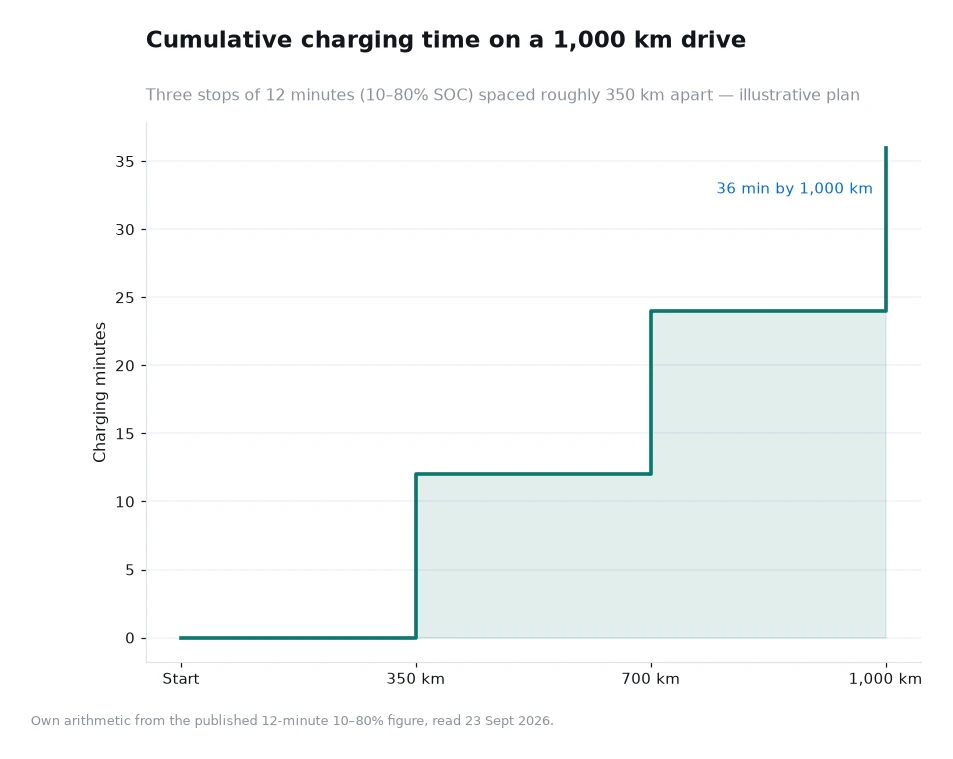
Warranty is not the only line worth checking, and a road-trip buyer should read the charging window next to it. Assume a 1,000 km drive with stops at about 350 km, 700 km and 1,000 km, each held to the published 10-80% window of 12 minutes. Three stops of 12 minutes give 12 + 12 + 12 = 36 minutes of charging for the trip, which works out at 3.6 minutes of charging for every 100 km covered.
Questions worth asking each dealer
Once the table is filled in, the dealer conversation gets sharper. Ask which service items are included at each interval, whether the owner app records the history automatically, and what happens to the remaining cover if you sell the car. Ask, too, whether roadside assistance transfers with the vehicle, because the published term runs seven years from first registration rather than from the day you buy it - on a two-year-old car you inherit five years of it, not seven.
Then check the practical geography. A warranty is only as useful as the workshop that honours it, so ask how far the nearest XPENG Authorised Dealer sits from home and whether they hold the parts a routine service usually needs. On a car with an eight-year key-parts term, a long round trip to a dealer twice a year becomes a real ownership cost, and it belongs in the comparison beside the service intervals themselves. For households with a second car, the same question applies to whichever vehicle ends up doing the long trips.
One more line belongs in the table if seven seats are a possibility. The larger X9 publishes the same warranty structure - 7 years or unlimited km on the vehicle, 8 years or 160,000 km on key parts, 5 years on paint and 7 on anti-corrosion - alongside 7 years of roadside assistance from first registration. Comparing a five-seat SUV with a seven-seat MPV on identical terms is the quickest way to see whether the extra seats change what you are paying for over time.
Frequently asked questions
Which warranty term should I compare first?
Start with the key-parts term, because it names the traction battery, battery management system, drive motor and intelligent power unit. On the New G6 that cover is 8 years or 160,000 km, with a minimum of 70% of original battery capacity.
How often is servicing due?
Every 12 months or 20,000 km, whichever comes first, and servicing is recommended through an XPENG Authorised Dealer. The owner's handbook and the warranty and maintenance manual carry the detail.
Build the comparison table before you negotiate
Write four rows on one page - vehicle term, key-parts term, service interval and roadside assistance - and fill them in for every car you consider. Then add a fifth row for your own annual distance, because that number decides which limit binds. A comparison you can read at a glance survives the pressure of a showroom conversation far better than a memory of what a salesperson said.
For the source figures, use the manufacturer's own pages rather than a summary: the XPENG service section carries the intervals and roadside terms, and the mid size electric suv model pages carry the equipment and charging detail. If seven seats are on the shortlist, the XPENG X9 pages publish the same warranty lines on a larger car.
Warranty terms, service intervals and charging figures come from the manufacturer's Australian site, read 23 Sept 2026; WLTP range depends on conditions, the traction battery warranty provides a minimum of 70% of original capacity during the key-parts period, and the service-count and charging arithmetic above are illustrative examples with stated assumptions.[1]